


Clearwater Industries’ dry polymer make-down systems include a lifetime warranty with the exclusive use of our chemistry. Our standard M-Series dry polymer systems are turnkey and automated to ensure reliable performance. The M-Series units provide a continuous and fully aged polymer solution, automated operation, and require minimal operator attention.
Our standard systems and custom designs can accommodate any polymer consumption, from a few pounds per day to hundreds of pounds per hour.
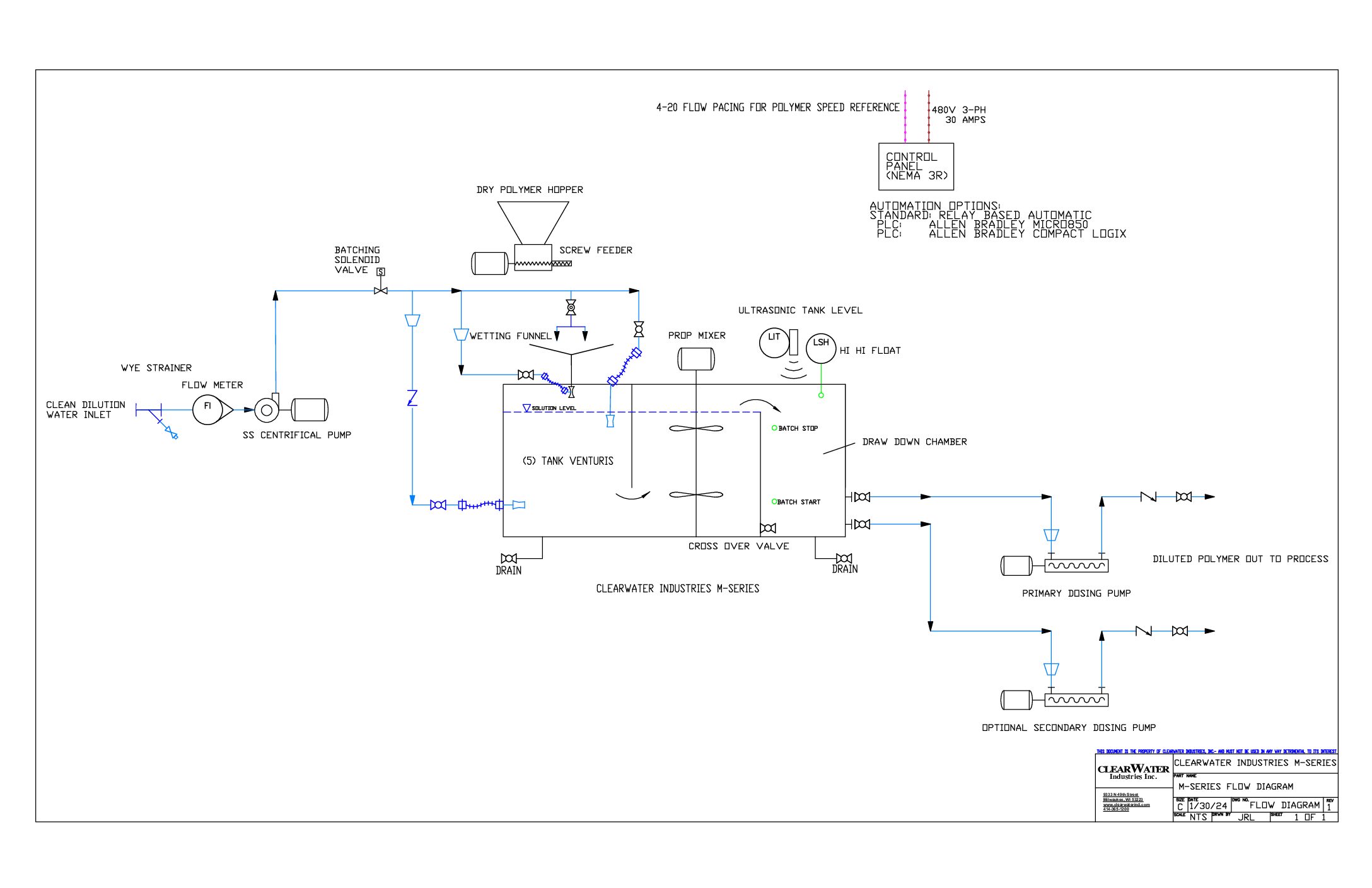
The system fully activates and ages the solution to minimize polymer consumption by featuring a single tank with three chambers. A variable-speed feeder automatically meters dry polymer to maintain a programmed solution strength. Proper polymer-particle wetting plus hydraulic and timed mechanical mixing deliver a uniform polymer solution. You can rely on our systems to accurately activate, age, and dose the polymer solution.
M-SERIES DRY POLYMER MAKE-DOWN SYSTEMS
| Model | Dosing Rate (GPM)* | Age Tank (Gal) | Length (in) | Width (in) | Height (in) | Weight Dry (lbs) | Weight Wet (lbs) | Power |
|---|---|---|---|---|---|---|---|---|
| M300SS | 0 – 5 | 495 | 146 | 72 | 82 | 2331 | 7446 | 480V/3Ph/30A |
| M500SS | 0 – 8 | 715 | 167 | 72 | 82 | 2632 | 9450 | 480V/3Ph/30A |
| M800SS | 0 – 12 | 1130 | 191 | 72 | 94 | 3333 | 16685 | 480V/3Ph/30A |
| M3000SS | 0 – 25 | 2275 | 240 | 89 | 111 | 4667 | 29703 | 480V/3Ph/30A |
| Custom | Any | Any | Any | Any | Any | Any | Any | Any |
*Dosing rate, or solution flow rate, is based on the recommended 90 minutes of aging.
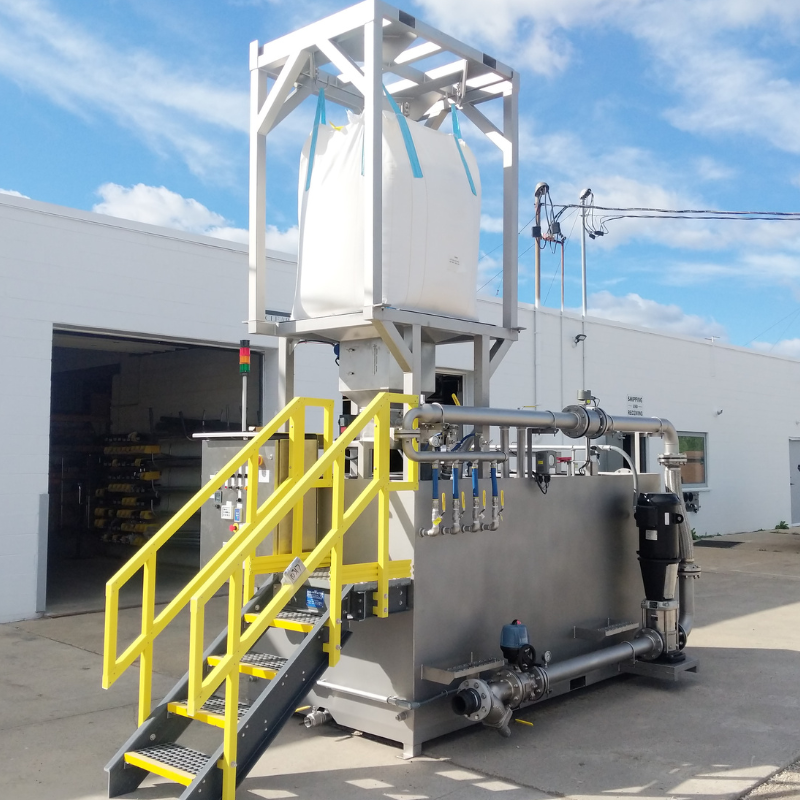
Although typically used to prepare polymer flocculants, we’ve customized units to prepare and dose aluminum sulfate, bentonite clay, lime slaker, powdered activated charcoal, starch, and more.
Standard Features
- 3/16 304SS tank glass blasted to uniform finish with fork slots
- 110 lbs 304SS dry polymer hopper
- Variable speed screw feeder
- Stainless steel conical wetting bowl creates a cyclone of water to ensure proper polymer-particle activation
- Hydraulic venturis mix the polymer in the first chamber
- Agitator with low-impact hydrofoil mechanically mixes the polymer solution in the second chamber
- Flowmeter prevents low-flow batching
- Progressive cavity polymer dosing pump with VFD for 4-20mA control mounted to the system
- 2″ dilution water Y-strainer
- (2) 2″ drain valves
- NEMA 3R control panel enclosure
- Hand/Off/Auto switch controls for automatic or manual control
- 480V motors with 120V logic and controls


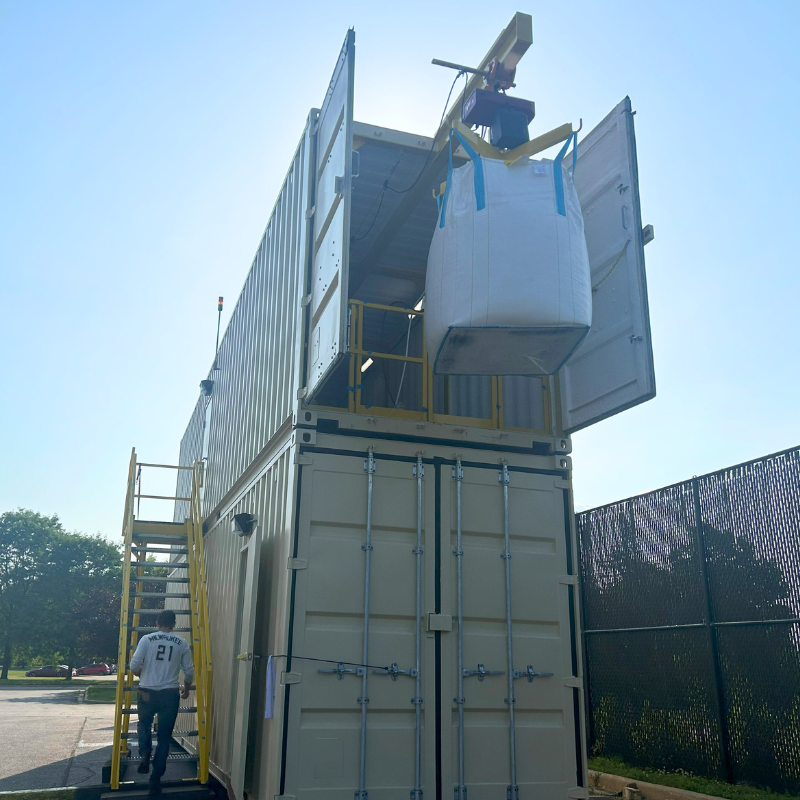
Big Bag Options
- 1650-2000 lbs Big Bag supports
- Big Bag Pan & Hopper
- Big Bag Tower
- Big Bag Hoist
- Request our Accessories Brochure to review options like vibrators and low polymer sensors


Optional Features
- 110 lbs sliding top hopper
- 220 lbs 304SS hopper. Hinged or sliding
- 1650 – 2000 lbs Big Bag setup
- PLC Controls
- Additional age tank for high polymer consumption applications
- AutoFloc Dosing System for automated polymer dosing
- Multi-gang manifold for multiple polymer dosing locations
- Additional polymer pumps
- Liquid polymer preparation system integration


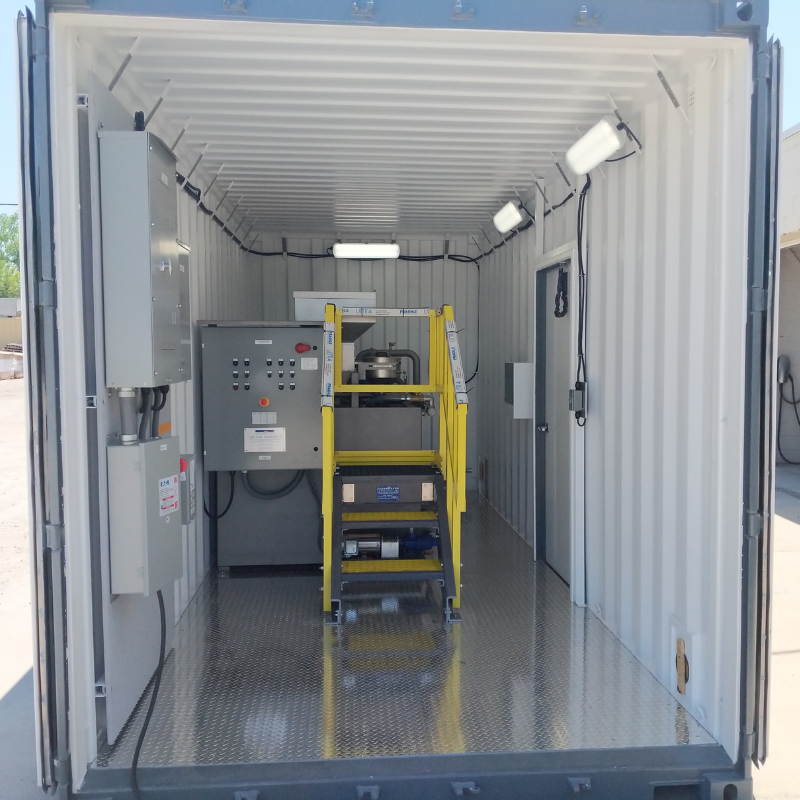
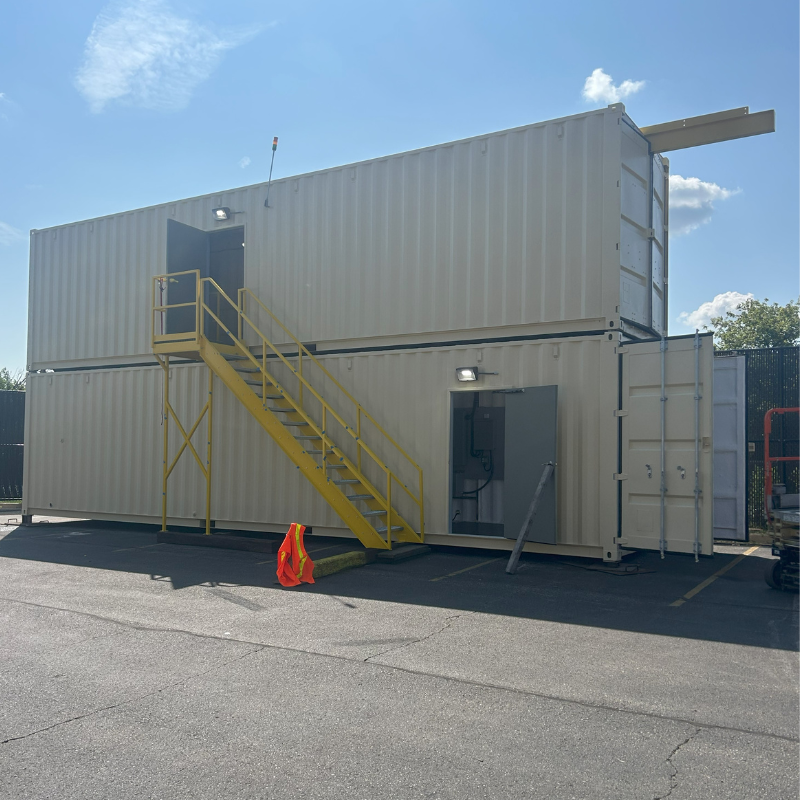
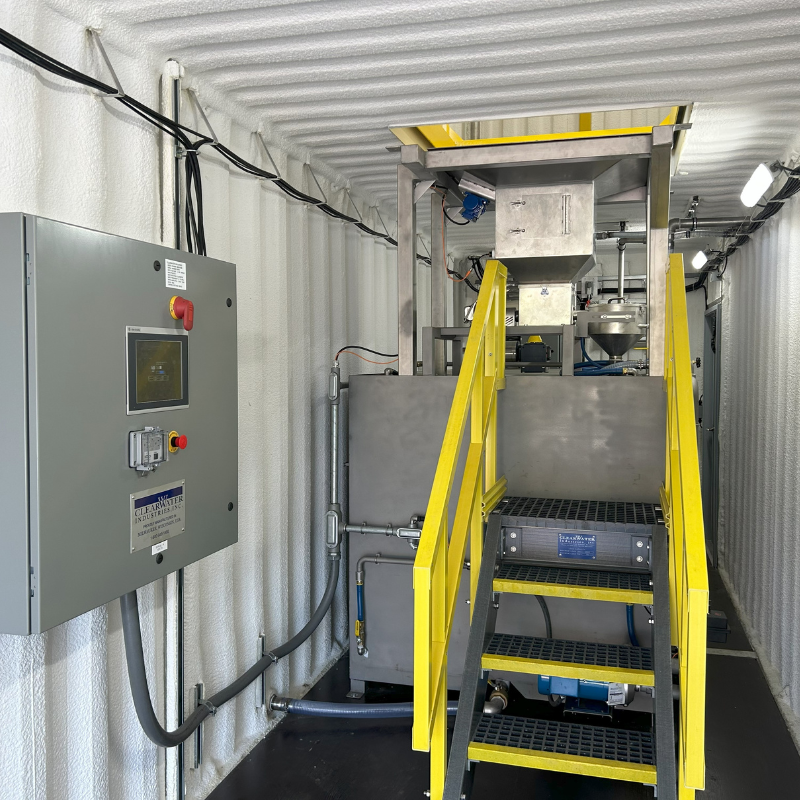
Containerized Systems
- 10′, 15′, 20′, & 40′ High Cube Conex Box options
- Double-stacked Conex Boxes fit big bags for high-consumption applications
- Single-point electrical hookup
- HVAC Climate-control
- Spray foam insulated
- LED Lighting
- Man door installed



Contact us and our team will answer your questions and determine the best system for your application.
VIDEOS
OPTIMIZED FOR YOU
Dry polymer systems need smart simplicity to meet limited operator requirements and support efficient polymer preparation. We achieve this with a few standard features on our M-Series line. First, our dry polymer feed systems automatically introduce the polymer granules to maintain a programmed solution strength. The granules are dispersed into a water cyclone in the wetting bowl, providing efficient initial activation. Next, the solution experiences high-energy hydraulic mixing to reduce agglomeration. From there, a second low-energy mechanical mixing stage continues to unravel the polymer without breaking the chains throughout the maturation process. Finally, the solution overflows a weir into the “drawdown chamber,” where it is pumped to process. The M-Series dry polymer make-down system offers precise control of dosing rate, dilution level, mixing time, and energy.
Dry polymers are typically the most cost-effective way to use flocculants. They contain 90+% active chemistry, while liquid polymers are closer to 30%. The active chemistry makes dry polymers ideal for liquid-solid separation, sludge dewatering, and potential cost savings.
We offer free jar testing to determine the best polymer, dosing rate, and equipment package for your application. In our lab, we’ll compare dry and liquid polymers to confirm flocculation efficiency, minimize consumption, and reduce cost. Contact us today for sample shipping instructions and to learn how we tailor a solution to your operation.
FAQs: DRY POLYMER MAKE-DOWN SYSTEMS
What size dry polymer system do I need?
Choose a dry polymer system model based on the consumption requirements for the application. Consumption can be defined as ppm or mg/L, pounds/hr, or the solution flow you need to deliver.
Our standard models are turnkey and provide the following flows: M300SS 0–5 GPM, the M500SS 0–8 GPM, the M800SS 0–12 GPM, and the M3000SS 0–25 GPM.
Custom designs handle anything from a few pounds per day to hundreds of pounds per hour. By incorporating an additional age tank, we can accommodate high-consumption applications of hundreds of gallons per minute.
Our team can confirm the right model for your application.
What is the pounds-per-hour capacity of a dry polymer system?
Clearwater’s standard systems can provide 200 lbs/hr of dry polymer. However, we don’t recommend operating our standard systems above 50 lbs/hr due to the available dilution water flow rate.
Custom systems can provide over 500 lbs/hr of dry polymer.
How does a dry polymer make-down system work?
A variable-speed feeder meters dry polymer into a stainless steel wetting bowl, where a water cyclone wets each particle. High-energy hydraulic mixing in the first chamber limits agglomeration. In the second chamber, a low-energy agitator continues to unravel the polymer without breaking the chains. The aged solution overflows a weir into the drawdown chamber and is pumped to the process.
How long does dry polymer need to age?
Clearwater’s M-Series dosing rates are based on a recommended 90-minute aging time. Aging gives the polymer time to fully activate, which helps minimize polymer consumption.
Is dry or liquid polymer more cost-effective?
Dry polymer is typically the most cost-effective flocculant option. It contains more than 90% active chemistry, lowering operational costs compared to liquid polymers, which have about 30% active chemistry.
Consider the capital costs of dry and liquid polymer systems along with estimated consumption. Dry polymer systems generally have a higher capital cost than liquid polymer systems.
Jar testing is the best way to compare dry and liquid polymers and estimate annual cost alongside capital equipment cost.
What else can a make-down system prepare besides polymer?
Although typically used for polymer flocculants, Clearwater has customized units to prepare and dose aluminum sulfate, bentonite clay, lime slaker, powdered activated charcoal, and starch.
Can I use big bags?
Yes, big bag options include 1,650–2,000 lb supports, a pan and hopper, a tower, or a hoist. Standard hoppers hold 110 lbs, with a 220 lb option.
Can I get a containerized dry polymer system?
Yes, containerized systems come in 10′, 15′, 20′, and 40′ high cube units, and double-stacked containers fit big bags for high-consumption applications. They include a single-point electrical hookup, HVAC, spray-foam insulation, and LED lighting.
How much operator attention does the system need?
Very little. The feeder automatically maintains a programmed solution strength, a flowmeter prevents low-flow batching, and a progressive cavity pump with VFD doses at a set flow or paces from a 4–20 mA signal. Hand/Off/Auto switches allow manual control.
PLC controls and the AutoFloc dosing system are optional. We also offer sensors with alarm outputs, such as low-level alarms in the polymer hopper and conductivity sensors to ensure solution strength.
What power and floor space does an M-Series system require?
Standard models run on 480V/3Ph/30A. Footprints range from 146″ × 72″ (M300SS) to 240″ × 89″ (M3000SS), and dry/wet weights are listed in the spec table above.
Is there a warranty?
Clearwater’s dry polymer make-down systems include a lifetime warranty, provided you use Clearwater chemistry exclusively. Systems that don’t use Clearwater chemistry have a standard 1-year warranty.
How do I find the right polymer and system for my application?
The best way to find the right polymer is to perform jar testing and determine the dosing rate. We test polymers in our lab to find the best product, dosing rate, and equipment package, and to confirm flocculation efficiency and minimize consumption.
What does a dry polymer system cost?
Cost depends on capacity, hopper or big bag setup, controls (standard or PLC), additional age tanks, number of dosing points, and whether the system is containerized. Contact us with your flow rate and polymer consumption, and we’ll provide a quote.